

AI Teaching & Learning Resource Guide
The School of Professional Studies is a unique community of scholar-practitioners, industry subject matter experts, and working professionals who are also adult learners. This interdisciplinary professional network is an ideal environment for knowledge sharing and finding ways to effectively leverage AI in both an educational and modern workplace context. This resource guide will equip instructors with an applied understanding of AI capabilities and limitations alongside best practices for incorporating AI in teaching and learning.
This guide will focus on core principles for acceptable AI usage, existing policies, and answers to common questions around AI. Although Artificial Intelligence is an expansive field, the primary focus of this resource will be limited to the scope of Generative AI within higher education. Before diving in, please be sure to familiarize yourself with the current Columbia Generative AI Policy, Best Practices for Responsible AI Use at Columbia, and the SPS Artificial Intelligence (AI) Policy for Faculty. You will also find additional Columbia-specific AI resources at the bottom of this page under Additional AI Resources. Feel free to jump to any section using the quick links in the upper right of this page.
Artificial Intelligence (AI) is rapidly transforming how we live, work, and interact with technology. From virtual assistants and recommendation systems to advanced tools in healthcare, finance, and education, AI is embedded in everyday experiences. Gaining AI literacy involves understanding the core concepts behind AI (including machine learning, deep learning, and automation) and how these technologies are applied in real-world scenarios. This foundational knowledge empowers individuals to engage meaningfully with AI systems, use them more effectively, and identify opportunities for innovation in both personal and professional contexts.
AI Literacy, at its essence, is the ability to understand, evaluate, and use AI systems responsibly and ethically. However, AI literacy has different definitions and connotations across industries. Within the context of teaching and learning in higher education, we will utilize the generative AI literacy framework proposed by Stanford, which identifies four intersecting domains of understanding.
- Functional literacy: How does AI work?
- Ethical literacy: How do you navigate the ethical issues of AI?
- Rhetorical literacy: How do you effectively prompt LLMs to achieve your goals?
- Pedagogical literacy: How do you use AI to enhance teaching and learning?
We encourage you to explore the microlearning videos above as a primer before diving into the AI Literacy learning module below. This learning module was designed as an introductory pathway for instructors, providing a baseline for AI literacy in the context of teaching and learning. You can expand each section as you move through the AI literacy competencies. You will find brief content summaries, practical step-by-step guides, interactive activities, links to external resources, and real-world examples to help ground your learning. There will also be a list of additional resources at the end of each section.
1. AI Literacy Pathway for Instructors
Functional Literacy
As defined above, AI literacy is a composite of skills and knowledge that an individual needs to confidently understand, ethically use, and critically evaluate AI tools. Instructors who are new to AI may be curious about the inner workings of how AI tools actually function. Some frequent questions may include:
- What is actually happening under the hood of generative AI, and why does it produce the kinds of responses you see?
- How do different AI tools really differ in practice, and how do you choose the right one for your work?
- Why does AI give different answers to the same prompt, and how do factors like training data, temperature, and model limits shape how much you can trust its output?
To begin building your AI literacy, we will focus on unpacking functional literacy with a brief overview of the building blocks of LLMs and an interactive LLM tutorial.
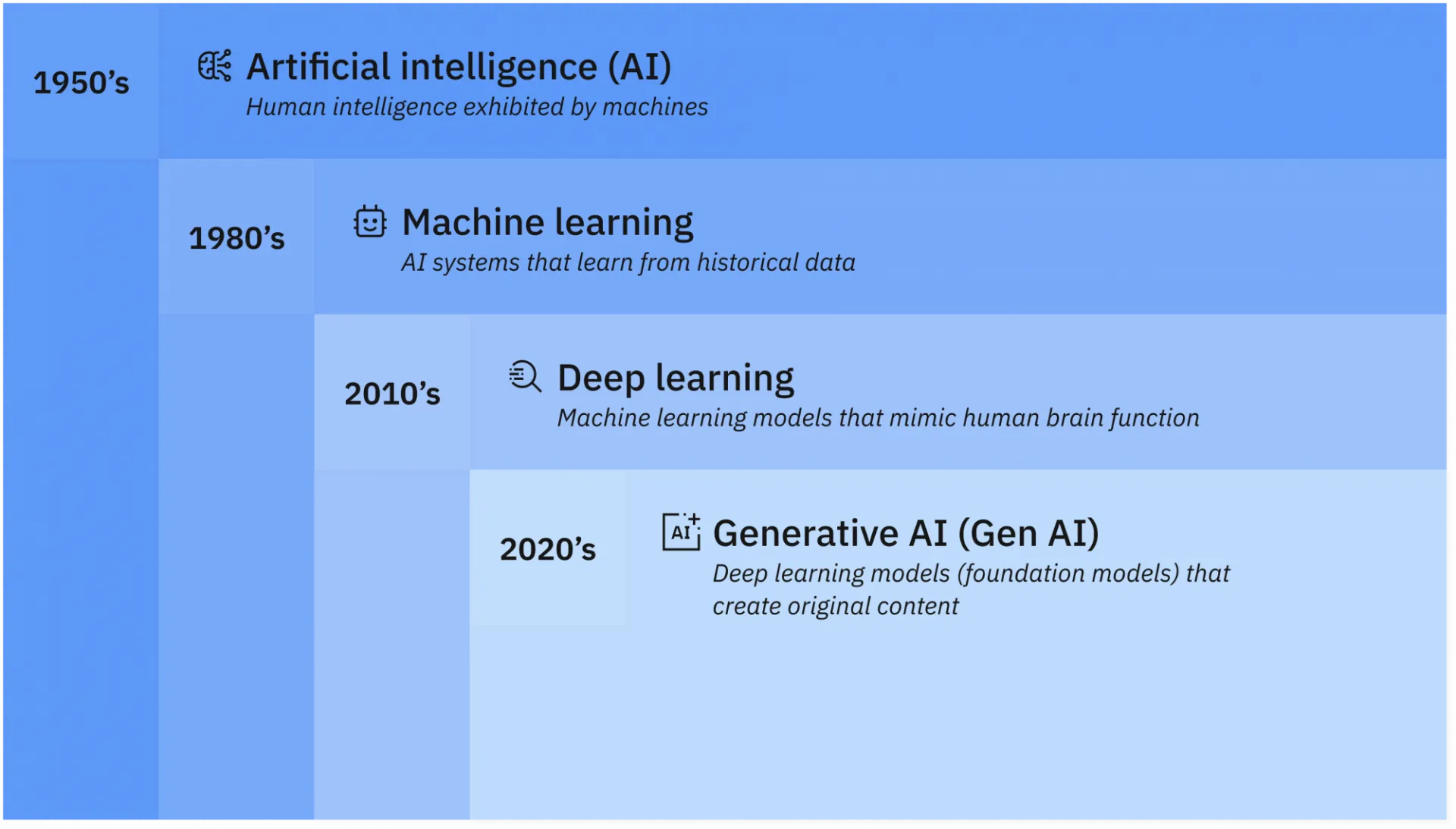
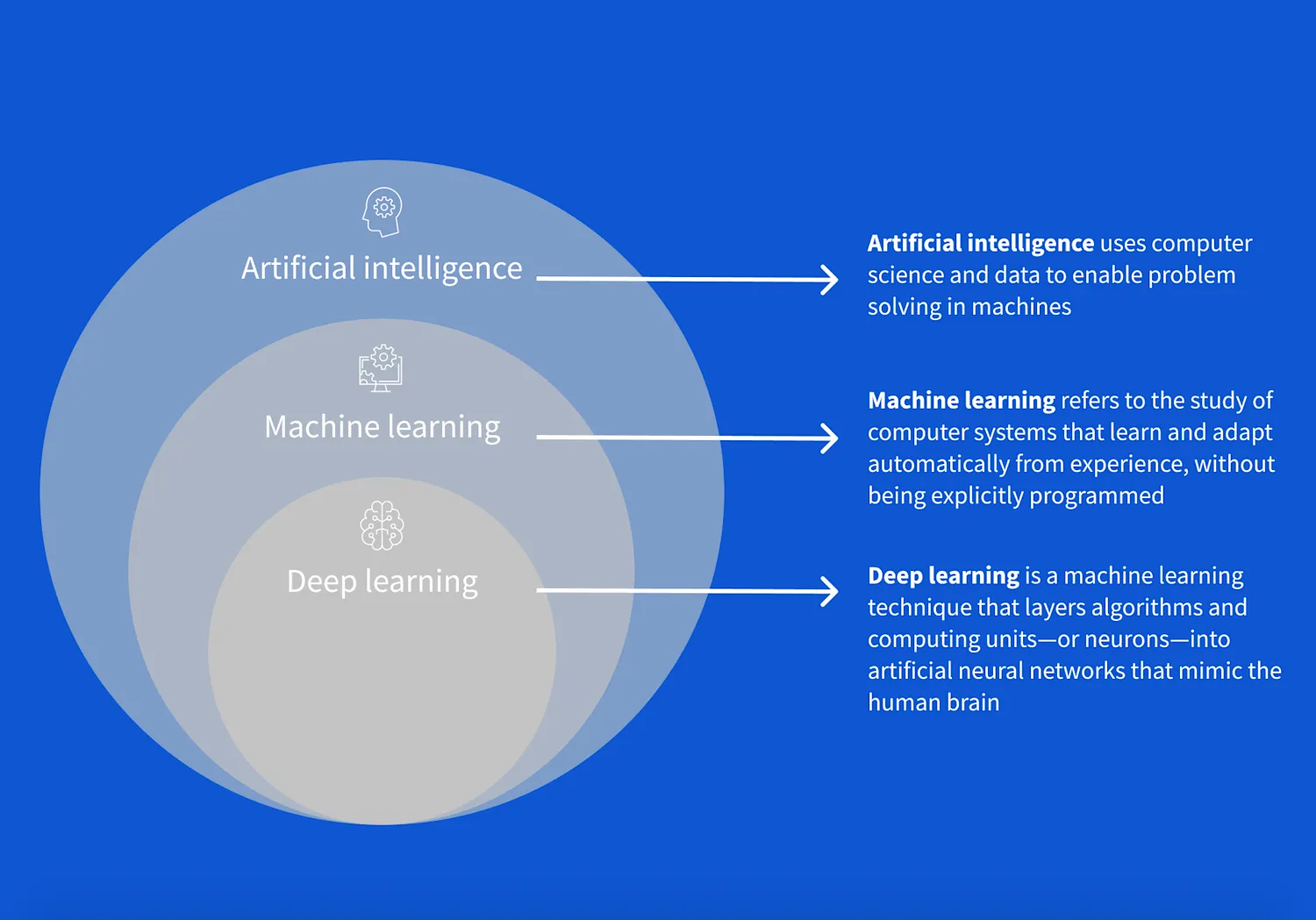
What is Artificial Intelligence?
Artificial Intelligence (AI) encompasses a broad range of technologies designed to simulate aspects of human intelligence, including learning, comprehension, reasoning, problem-solving, and decision-making. The term Generative AI (Gen-AI) refers to systems that can create new content rather than just analyze existing data. Generative AI is built on a deep learning model that serves as the basis for many types of generative AI applications, known as a “foundation model."
The most common foundation models today are large language models (LLMs), designed for natural language processing tasks. In addition to text-based models, there are also foundation models for images, videos, audio, and multimodal models that support various types of content. The largest and most high-performing LLMs are generative pre-trained transformers (GPTs) and provide the core capabilities of chatbots such as ChatGPT, Copilot, Gemini, and Claude.
How Does AI Work? A Guided Tutorial
To understand LLMs and see Generative AI tools in action, please complete the 3-part interactive tutorial below. Ensure that you have a clear understanding of key terminology and the building blocks of machine learning that make AI possible. You will also have the opportunity to compare and contrast LLMs from various companies.
Complete this Tutorial
Visit: AI Guide (AI Pedagogy Project)
- Part 1: AI Starter introduces foundational concepts, explores AI’s strengths and limitations, and offers sample classroom policies.
- Part 2: Explore LLMs invites you to compare ChatGPT and Claude and experiment with the settings, prompts, and temperature of these tools to see how subtle adjustments can shape their responses.
- Part 3: Resources offers extra materials, including a sample AI Code of Conduct, academic integrity resources, and curated links to help you dive deeper.
Reflect & Apply: Hands-on Functional Literacy
Use the following questions to guide discussion or personal reflection:
- After completing this tutorial, how might you describe LLMs to someone in your field?
- Comparing LLMs like ChatGPT and Claude, did you notice any key differences once you began to explore? What capabilities and limitations did you encounter with each?
- When evaluating LLM outputs, how would you describe the importance of things like training data, tuning, and model limits to one of your students?
Additional Resources on Functional Literacy
- Quick, Draw! — Training the model: Draw objects and see how a model predicts what they are in real time.
- TensorFlow Playground — Experiment with a simple neural network to see how layers and nodes work together to learn patterns.
- What is artificial intelligence (AI)? — IBM overview of the history of AI
- What Is ChatGPT Doing … and Why Does It Work? — A deep dive into how ChatGPT functions.
- Wharton Interactive Crash Course: Practical AI for Instructors and Students — A practical introduction to AI with Ethan Mollick and Lilach Mollick.
- Co-Intelligence by Ethan Mollick — Considered “the definitive playbook for working, learning, and living in the new age of AI”, this quick read is well worth the time to understand our AI present and future.
Takeaways
Grasping the basics of functional literacy in AI is like unlocking a new set of teaching tools. It helps you choose and apply AI tools that can truly enrich your classroom. Engaging with tutorials and real-world examples will guide you as you explore AI's potential. Keep an open mind and stay curious—AI is always changing, and being informed will ensure you make the most of its benefits for you and your students.
Ethical Literacy
Deciding how and when to use generative AI responsibly requires understanding several ethical issues related to the creation and application of the tools. This Ethical Literacy is especially necessary for instructors, since your students will look to you as models of intentional and transparent AI use.
This section will explore:
- What ethical issues exist related to the creation and use of AI tools, and how do you consider these issues when planning and teaching your course?
- What do you consider responsible and ethical AI use in your teaching, and how do you articulate that stance to students?
- How can you choose and use AI tools in ways that actively support fairness, inclusion, and transparency rather than undermine them?
Why This Matters
Artificial intelligence is reshaping teaching and learning in higher education, offering new opportunities alongside significant challenges. At SPS, ethical literacy is about helping faculty and program leaders understand those challenges and navigate them thoughtfully. Rather than prescribing rules, this section invites reflection: How do you use AI responsibly in ways that uphold integrity, fairness, and inclusion? How do you prepare students to do the same?
Faculty feedback, including results from the SPS AI Needs Assessment, reinforces a shared interest in using AI responsibly and transparently across disciplines. This section contributes to a broader SPS initiative to support faculty in developing informed, discipline-specific approaches to AI integration. It provides guidance and examples—not directives—encouraging each instructor to develop an ethical stance appropriate to their course, program, or professional field.
Core Concepts
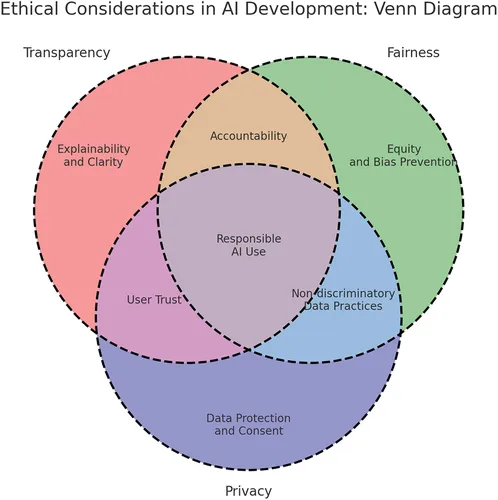
Ethical literacy involves awareness of the characteristics of AI tools and the values and potential impacts of the way they are used, which have an impact in higher education and beyond. The following core concepts give a snapshot into eight of the key ethical considerations around whether and how to use AI:
- Bias: AI systems learn from data that reflects historical and systemic biases, which means they can perpetuate or amplify inequalities related to race, gender, age, disability, and other factors, especially when their outputs are accepted without critical thought and foundational AI literacy. In educational contexts, biased AI outputs might reinforce stereotypes, provide unequal support to different student groups, or disadvantage students from underrepresented backgrounds.
- Environmental Impact:
Training and running large AI models requires significant computational power, resulting in substantial energy consumption, water usage, and carbon emissions. The emerging research on this energy consumption is still taking shape, but especially at a local level, there are significant and inequitably distributed impacts from new data centers and energy imbalances. Advocates are fighting for more responsible environmental practices, like the use of renewables to power data centers, but AI infrastructure is being built and powered faster than this advocacy can take full effect.
- Truth & Hallucination:
AI language models can generate convincing but factually incorrect information, a phenomenon known as "hallucination," without any indication that the content is unreliable. This poses particular risks in educational settings where accuracy is paramount, and students may lack the expertise to verify AI-generated content. Teaching students to critically evaluate and fact-check AI outputs is crucial for maintaining academic integrity and information literacy, especially given the biases that may emerge in these hallucinations as discussed above.
- Privacy & Copyright:
AI systems are trained on vast amounts of data, often without clear consent from the individuals or creators whose work is included, raising concerns about both personal privacy and intellectual property rights. When using AI in education, sensitive student data or proprietary materials might be processed by third-party companies with unclear data practices unless you're using one of the "walled garden" tools provided by Columbia. Educators must understand what data is being collected, how it's being used, and whether a given tool is appropriate for a given task, remembering to pay particular attention to confidentiality and restrictions like HIPAA and FERPA, as relevant.
- Human Labor:
The development and maintenance of AI systems depends on often-invisible human labor, including low-paid data annotators and content moderators, frequently working under difficult conditions in the Global South. Additionally, AI tools may displace certain types of work or devalue skills that have traditionally been central to education, such as writing and research.
- Power: AI tools are predominantly developed and controlled by a small number of large technology companies, concentrating power over how these tools function and who benefits from them. On a local level in education, companies make decisions about data usage, feature prioritization, and access that directly affect both educators and students, often without their input. And on a national and global level, AI tools are integrated into areas of daily life and government, like judicial systems, with at times disastrous and, once again, deeply inequitable impacts.
- Access & Adoption Gaps: Beyond the tools themselves, not all students, educators, or institutions have equal access to AI tools, training, or the infrastructure needed to use them effectively, potentially widening existing educational inequities. Additionally, while AI tools have the potential to help facilitate increased accessibility for students with disabilities, some AI interfaces can also present accessibility barriers for users with disabilities, creating exclusion rather than inclusion. Thoughtful implementation requires addressing these disparities and ensuring that AI adoption doesn't leave certain communities further behind.
- Academic Integrity: In education in particular, AI tools capable of generating essays, solving problems, and completing assignments challenge traditional assessment methods and can amplify existing academic integrity concerns. Rather than responding with increased surveillance or suspicion, educators have an opportunity to redesign assessments that emphasize learning processes, critical thinking, and authentic demonstration of learning (see the section on Pedagogical AI Literacy below). Communicating clearly and openly with students about how, when, and why they may use (or not use) AI in your courses for different tasks is also essential, and AI policy statements are a helpful starting place for those conversations. Maintaining a foundation of trust while adapting your pedagogical approaches is essential for fostering genuine learning in an AI-enabled environment and can lay the groundwork for students being open about their own AI practice.
A note on AI detectors: No AI detection software is 100% reliable, and many have substantial error rates, including false positives, which can lead instructors to wrongly accuse students of academic dishonesty. Even Columbia-approved tools like Turnitin’s AI Checker must be used responsibly and as part of a larger conversation with students to be useful tools in navigating AI in education. Find more information in SPS’s Turnitin Fact Sheet and Turnitin’s AI detection documentation.
Moving Forward: Practice, Transparency, and Advocacy
Navigating AI use given these ethical considerations involves making intentional choices about your practice (how do you use AI and when given the current limitations of the tools?), transparency (how do you talk about and make your use of AI visible?), and advocacy (how do you build towards better tools, data, and labor practices in the future?). Modeling these intentional choices for your students helps create trust in your courses and build towards a collaborative, responsive AI culture at SPS.
Reflect & Apply: From Awareness to Action
Use the following questions to guide discussion or personal reflection:
- What are some values that shape the use of AI in your field?
- What values should shape AI use in your classroom or program?
- When does AI enhance student learning, and when might it displace essential cognitive work?
- How will you communicate expectations around AI use to students, colleagues, or teaching assistants?
Example Scenarios for Ethical Reflection
Facilitating Designed Reflections
- In a Strategic Communication course, students might use a chatbot to generate alternative versions of a campaign message. Rather than focusing only on quality, the class could examine how tone, framing, or cultural assumptions shift across outputs—and what those differences reveal about bias or audience impact.
- In a Data Analytics course, students might compare AI-generated insights with results from their own models. This can prompt discussion about where AI performs well, where it struggles, and how algorithmic choices—or training data—shape fairness, accuracy, and real-world consequences.
Responsive Reflection
- A student raises a personal objection to using AI for a required assignment. How might this relate to other forms of conscientious objection in academic settings, whether accommodated or not? What options do you have to acknowledge the student’s concern while still meeting the learning objectives of the course?
- Some students are uneasy about faculty using AI in ways that shape their learning experience. How might you balance those concerns with your teaching goals, disciplinary norms, or accessibility needs? In what situations could AI use support learning or efficiency, and when might it undermine trust or student agency?
- A fellow faculty member is loading student course data into a personal AI agent to better distinguish academic integrity violations. What concerns may this raise?
By considering short reflective activities like these, instructors help students—and themselves—develop informed, critical habits of AI use.
Resources & Tools
Guidelines and Frameworks
EDUCAUSE – AI Ethical Guidelines (https://library.educause.edu/resources/2025/6/ai-ethical-guidelines)
UNESCO – Recommendation on the Ethics of Artificial Intelligence (https://www.unesco.org/en/artificial-intelligence/recommendation-ethics)
Leon Furze – Teaching AI Ethics (https://leonfurze.com/2023/01/26/teaching-ai-ethics/)
Education-Focused Resources
QM Guidance on Citing AI Use - https://docs.google.com/document/d/1B_kzvi2Pvx0IY4AzTM0zcxN57x15ePXGqnnpJXS4CkU/edit?tab=t.0#heading=h.r1qxtrxq831e
Cornell CTI – Ethical AI for Teaching and Learning (https://teaching.cornell.edu/generative-artificial-intelligence/ethical-ai-teaching-and-learning)
MIT Sloan – AI Bias and Hallucinations in Practice (https://mitsloan.mit.edu/ideas-made-to-matter/how-combat-ai-bias-and-hallucinations)
Interactive & Case-Based Resources
AI Pedagogy Project – metaLAB, Harvard (https://aipedagogy.metalabharvard.edu/)
AI for Education Network – Navigating AI Ethics in Education (https://www.aiforeducation.io/navigating-ai-ethics-in-education-from-deepfakes-to-academic-integrity)
CU Policies and Tools
Columbia University Center for Student Success & Intervention – Academic Integrity Policies (https://cssi.columbia.edu/content/academic-violations)
Takeaways
Ethical literacy begins with awareness but grows through practice. It encourages faculty to ask questions rather than seek definitive answers—recognizing that the ethical landscape of AI will continue to evolve. At SPS, we invite instructors to model transparency, curiosity, and care in their use of AI, fostering a culture where innovation and responsibility go hand in hand.
Rhetorical Literacy
Traditionally, ‘Rhetoric’ is defined as “the art of speaking or writing effectively.” So when we speak of "Rhetorical literacy" in the context of AI, we are referring to your ability to give clear instructions to AI tools in order to elicit desirable, quality outputs. Simply put: how can we write better prompts to get better results? In this domain of the AI Literacy Framework, rhetoric encompasses how we use language to explore and express our ideas and achieve our objectives. By developing your rhetorical skills and awareness, you will start to be able to enlist generative AI as a collaborator and to better evaluate the quality of the outputs from these tools.
- What are some effective ways to ask good questions that achieve quality results when prompting LLMs?
- What is 'prompt engineering' and how can using different prompting techniques improve the output of AI tools?
- How might you evaluate outputs and utilize iteration to refine outputs for a more polished final product?
What is a Prompt?
A prompt is the language (or input) you use to define the scope of the task or output you’re seeking from a generative AI tool: it’s essentially the instructions for what you want generated. Let’s say you’re using AI to help you draft a real-world example to demonstrate the applicability of a concept you’re teaching in your class. However, how you frame your prompt will affect the relevance and efficacy of the AI response produced. Certainly, you would explain the income tax system differently to a class of fourth graders than to a graduate-level Actuarial Science class.
Early in your journey with these tools, you might find that the responses to your prompts feel general and even stilted. The more effectively you develop your prompting language skills – your rhetorical literacy – the higher quality your results will be.
What Makes a Good Prompt?
While there are a number of effective methodologies that have been developed for how to develop strong AI prompts, such as Lance Cumming’s Structured Approach, or Sébastien Bauer’s Rhetorical Approach, they all consistently recommend similar principles to help you better frame your requests. When writing prompts, using general best practice tips like these can help you get closer to the results you want:
General design patterns for optimizing prompts include:
- Being specific and clear
- Structure input and output
- Add special characters (e.g., delimiters) for improving the structure of prompts
- Simplifying and breaking tasks into simpler subtasks
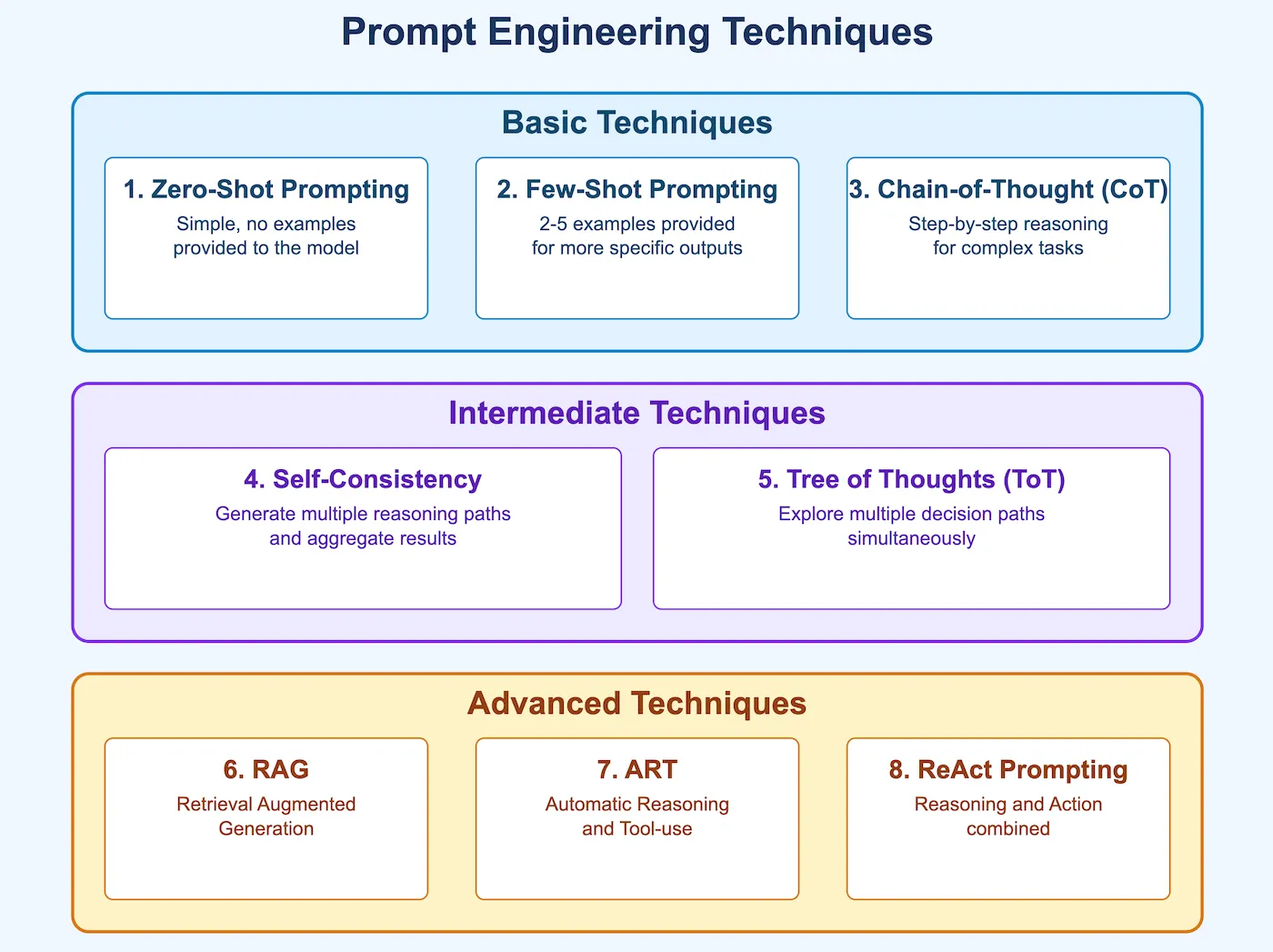
- Prompting strategies:
- Adding demonstrations and relevant context (e.g., few-shot)
- Think set-by-step (e.g., Chain-of-thought)
- Elicit effective and efficient advanced reasoning, planning, and tool use (e.g. ReAct)
Some popular prompt frameworks include CREATE, ROSES, and RACE. You may choose different prompt frameworks depending on the purposes or LLMs. However, the key takeaway is that the more specific you are with your input instructions and context, the higher the quality of your outputs will become. In the prompt engineering guide below, you will learn the importance of using specific frameworks or prompting techniques to improve your outputs.
What is Prompt Engineering? A Guided Tutorial
Prompt engineering is the process of crafting and refining prompts to achieve more desirable outputs from generative AI models. To understand the core tenets of prompt engineering, we ask that you complete a series of brief learning modules from the Prompt Engineering Guide below.
Complete this Tutorial
Prompt Engineering Guide (Learn Prompting)
If you are new to prompt engineering, we recommend working through the following modules of the Prompt Engineering Guide. Once you have completed the introductory modules listed below, you can explore prompt and context engineering more deeply with the additional resources provided.
- Introduction to Prompt Engineering - Introduction to the concept of prompt engineering, a crucial skill for working with LLMs
- Basic Prompt Structure and Key Parts - Outlining a basic framework of key components for building prompts
- Technique #1: Instructions in Prompts
- Technique #2: Roles in Prompts
- Technique #3: Examples in Prompts: From Zero-Shots to Few-Shot
- Combining Prompting Techniques
- Tips for Writing Better Prompts
If you are already familiar with the basics of prompt engineering and prompting techniques, then we encourage you to explore these advanced resources on your own:
- Advanced Prompt Engineering (CUIT)
- Context Engineering 101 (CUIT)
- Advanced Context Engineering (CUIT)
- Context Engineering Guide (DAIR.AI)
Reflect & Apply: Hands-on Rhetorical Literacy
Use the following questions to guide discussion or personal reflection:
- After working through this section, how would you describe to a colleague or a student the ways in which the structure of a prompt, such as the role I assign, the audience I name, and the specific task I outline, influences the clarity and usefulness of the AI’s response?
- When an AI response does not fully address your instructional needs, how might you approach revising your prompt so that the next output is more closely aligned with your goals for the activity or lesson?
- As you review AI-generated content, what criteria would you use to determine whether the information is accurate, appropriate for your students, and suitable for use in a teaching or learning setting?
- What elements of prompt engineering will be most important for your students to understand to use AI successfully in your field?
Additional Resources on Rhetorical Literacy
- A Columbia Prompt Library for Effective Academic AI Use — A practical prompt library created by CUIT for academic use-cases
- 12 Prompt Engineering Techniques; Medium — Provides a concise description of 12 different prompt engineering techniques and how they work.
- How can educators get started with ChatGPT? — OpenAI, in collaboration with Ethan Mollick and Lilach Mollick, provides some examples of specific prompts you can use in different educational scenarios.
- Custom Instructions for Chat GPT — OpenAI’s guide for how to set, save, and apply custom instructions for your chats so you don’t need to start every chat from scratch.
- The practical guide for using AI to do stuff by Ethan Mollick — A practical guide with examples of ways to use AI for various tasks
- Prompt Engineering: The Art of Getting What You Need From Generative AI by Stephanie Kadel — An accessible discussion of how rhetorical clarity, task framing, and audience considerations shape the quality of AI-generated responses.
Takeaways
Generative AI is an evolving technology, so prompt and context engineering best practices will also continue to develop over time. Trying out different prompt structures and frameworks will help you move towards finding the techniques that work best for you and your particular use cases—and to be able to teach your students about these rhetorical techniques in turn.
Pedagogical Literacy
As you navigate teaching in an AI world, these questions probably sound familiar.
- How does AI actually reshape how students learn? When you're designing a course, how do you know if AI will support the learning process or short-circuit it?
- When does AI enhance learning, and when does it get in the way? How do you evaluate the pedagogical potential and limitations of AI-powered tools?
- How can you still teach and assess what matters? Traditional assignments may be easily completed by AI, so how do you design assessments that measure real thinking and understanding?
- Are your students becoming dependent instead of capable? You don’t want AI to be a crutch that prevents students from developing their essential capabilities. How do you adapt instructional practices to mitigate risks where AI may undermine learning goals, academic integrity, or inclusivity?
- How can you assess if your use of AI is actually improving learning? When you integrate AI into your course, how do you ensure it promotes problem-solving, critical thinking, and learner autonomy?
If these questions resonate, this section is for you. The answers aren't simple, but the framework for thinking through them is grounded in what we know about how people learn.
AI doesn't replace good teaching. It reveals it.
AI is neither savior nor villain in the classroom. It's an amplifier. It amplifies good pedagogy and exposes weak pedagogy. It can enhance active learning or encourage passive consumption. It can support critical thinking or replace it. The difference comes down to pedagogical literacy: the ability to evaluate, adapt, and intentionally design learning experiences in an AI-enabled world to deepen, not diminish, student growth. Pedagogical literacy is about understanding this landscape, recognizing both opportunities and threats, so you can make informed choices about if, when, and how AI fits into your teaching practice.
This section isn't about using AI. It's about teaching well when AI exists, whether you choose to integrate it or not.
Core Questions: Rethinking Teaching and Learning When AI Exists
The fundamental questions of teaching and learning design haven't changed. What's changed is how you might answer them when AI is in the mix. These questions are grounded in learning theories, learning design methods, and cognitive science, frameworks that have guided effective teaching long before AI and will continue to guide it after.
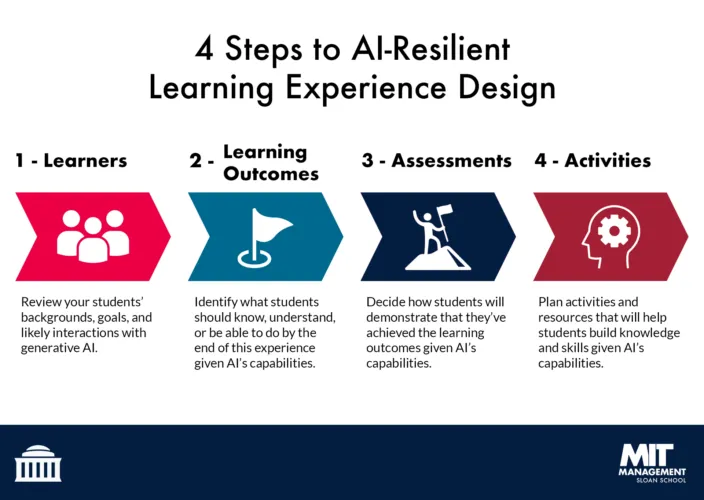
The section below is informed by the Backward Design framework (Wiggins & McTighe, 2005) and MIT Sloan's guide to designing AI-resilient learning experiences. When considering the (re)design of your course in the age of AI, use the following core questions as your guide:
1. What should students actually learn?
2. How do you know students learned it?
3. How do you design learning that sticks?
What should students actually learn?
Start with the end in mind: What do you want students to know, understand, or be able to do by the end of your course? In an AI world, this question becomes more critical because it forces clarity about what learning outcomes are meaningful and relevant for students' futures.
Review your learning objectives: Are your learning objectives focused on content knowledge that students could look up or generate with AI? Or do they emphasize skills like critical analysis, creative problem-solving, disciplinary thinking, and metacognition, capabilities that require practice and can't be outsourced? For example:
- "Students will be able to summarize research articles." → AI does this instantly
- "Students will be able to evaluate which research methods are appropriate for different questions." → This requires judgment AI can't replicate.
Prioritize high-level, transferable human skills: As AI takes over routine tasks like information retrieval and synthesis, learning objectives should prioritize higher-order, transferable human skills. Consider emphasizing disciplinary thinking: the ability to apply the concepts, skills, and ways of reasoning inherent in a particular academic field to critically analyze information, make informed judgments, solve problems, and communicate effectively within that domain. These capabilities, such as critical thinking, problem-solving, decision-making, and metacognition, cannot be outsourced to algorithms. They are essential for fostering learning transfer, which prepares students to adapt to dynamic real-world situations.
Ensure real-world relevance: Are your learning objectives preparing students for situations they'll actually face? In most professional contexts, people will use AI. The question, then, is not whether students can use AI, but how they use it. Can they evaluate its output critically, apply their disciplinary expertise, and make sound decisions? Developing this kind of discernment and human judgment is central to meaningful learning in the age of AI.
How can AI help with this question: AI can’t determine what students should learn, but it can help you clarify, articulate, and stress-test your decisions about what matters most. It’s a brainstorming partner, not the decision-maker. When used thoughtfully, AI can sharpen your focus on what truly endures: human judgment, reasoning, creativity, and ethical discernment while helping you align your learning objectives with professional standards or workplace competencies. Consult the resource, Writing Learning Objectives.pdf, for guidance on writing learning objectives (LOs) corresponding to different cognitive skills.
How do you know students learned it?
This is really two related questions: What evidence demonstrates understanding? And how do you gather that evidence in ways that reveal genuine learning rather than AI-assisted completion?
Define evidence of learning: Understanding isn't just getting the right answer; it’s about demonstrating how and why. Evidence of learning appears when students can explain their reasoning, locate and use appropriate resources, apply knowledge in new situations, evaluate the effectiveness of an approach, adapt when contexts change, ask insightful questions, and integrate ideas to create better solutions.
Gather evidence of learning: In an age when AI can produce outputs, authentic evidence of learning should go beyond the final product. What matters is the process: how students think, reason, and adapt along the way. You can gather this evidence through multiple ways:
- Observe when and how learning unfolds: Watch how students approach problems in class or during online discussions. Ask them to explain their thinking out loud or identify where they feel stuck. These insights reveal an understanding that an AI-generated response can’t show.
- Make thinking visible: Ask students to show their work, not just the final answer, but how they got there. Promote deep thinking and reflection with questions such as: What did they try first? What made them change direction? What challenges did they encounter, and how did they resolve them? What assumptions guided their thinking? If AI was part of the process, have them explain how they used it responsibly and what decisions still required their own judgment.
- Design for authentic application: Create assessments that require using knowledge in specific contexts AI doesn't have access to: their own workplace observations, specific case details you provide only during the assessment, or problems that require integrating course concepts with their personal contexts.
- Elicit understanding in real time through conversation: Use dialogue to reveal reasoning. Ask students to defend their choices, explain decision-making, or apply concepts to new scenarios you pose in real-time. Though harder to scale, these exchanges often yield first-hand evidence of genuine learning.
Example assessment redesign
- Product-focused: Submit a 12-page market research (group project).
- Process-focused: Submit the 12-page market research report PLUS your initial notes identifying key research questions, a reflection on how your analysis evolved, documentation of challenges encountered and how your team addressed them, and a brief team reflection on collaboration and decision-making.
How can AI help with this question? For instructors, AI can support the assessment (re)design process as both a testing partner and a design collaborator. Try using an AI tool to complete your assignment as though you were a student: if AI can easily create the product you’re asking students to submit, that’s a cue to redesign your task so it emphasizes reasoning, context, and reflection rather than polished output. While designing this kind of authentic assessment takes time, AI can lighten the load by drafting clear instructions, generating scenario examples, and suggesting reflection prompts for the students. You can also ask the AI to take a student perspective and ask you questions about your assignment to help make it even stronger. While AI can assist in design, instructors should avoid outsourcing qualitative feedback to the tool, as human judgment and discipline-specific expertise remain essential for student growth. For students, AI can be a thinking partner rather than a shortcut. Encourage students to use AI to brainstorm, organize ideas, or critique their analytical choices, then document how the tool shaped their process. They should explain what AI contributed, where it erred, and what decisions required human reasoning. Used this way, AI becomes a thinking companion that strengthens metacognition, digital literacy, and professional accountability.
How do you design learning that sticks?
Designing for lasting learning means going beyond content delivery to create experiences that engage, challenge, and stretch students’ thinking. Learning “sticks” when students do something meaningful with knowledge rather than just encounter it. In an AI-enabled world, this means designing activities and materials that make thinking visible, require judgment, and invite productive struggle.
Ground learning in active engagement: Students learn by active engagement with knowledge and skills. They construct understanding and make meaning when they analyze, question, discuss, apply, and connect new ideas to prior knowledge through meaningful cognitive activities. Effective learning design prompts learners to interact with content, peers, and real-world problems. Replace passive consumption with cognitive engagement, transforming information into understanding. For example:
- “Watch this lecture video on ethical dilemmas in AI.” → “Use the video cases to identify a moment of ethical ambiguity and propose two alternative actions, justifying each.”
- “Summarize the reading.” → “Compare the author’s framework with another you’ve studied: where do they align, and where do they conflict?”
Design for cognitive effort: Deep learning often involves discomfort when students are pushed to think hard and grapple with complexity. Effective learning design scaffolds this productive struggle so that students persist rather than avoid it. Sequence activities so each step builds on the last, moving from guided practice to independent application. Allow space for mistakes, reflection, and iteration. These are where learning solidifies.
- Example: In a data analysis course, if students are simply asked to produce statistical summaries or visualizations, they can easily use AI tools to generate polished outputs without engaging deeply with the reasoning behind them. To design for cognitive effort, begin with a warm-up activity where students explore a dataset and articulate what they notice, question, or assume about it. Then, a conceptual deep dive: provide a guided example to help them unpack core analytical concepts such as variable relationships, data cleaning, or model selection. Next, practice activity: have students apply and adapt these methods to a novel dataset or research question, and finally critique their own or peers’ analytical choices and interpretations.
- If students use AI as an analytical or coding assistant, have them document their process, share the prompts they used, and evaluate AI’s role and output, pushing them to reflect on when, how, and why AI supports analysis, and where human judgment remains essential.
Use materials as thinking tools, not just content containers: In an AI-rich environment, content is everywhere. The value of course materials lies in how they structure thinking and guide learning. Curate readings, media, and tools that illuminate disciplinary reasoning: how experts pose questions, gather evidence, and make judgments. Annotate or model how to read, interpret, and interrogate sources rather than just assigning them. For example:
- “Read Chapter 5 on research design.” → “Read Chapter 5 and identify three design choices the author made. How would different choices change the results? Bring one question you have about this chapter to guide discussion in class.”
How can AI help with this question? AI can amplify learning activities and materials by acting as a flexible scaffold that supports rather than replaces meaningful cognitive work. For instructors, LLMs can speed up design by generating variations of prompts, practice problems, and case studies, helping you experiment with ways to sequence or scaffold complex skills. AI can also serve as a thinking partner as you create differentiated/personalized materials that guide students with different levels through productive struggle. For students, AI becomes an always-available study partner that provides alternative explanations, generates examples to illustrate abstract concepts, or helps them organize information without doing the thinking for them. Tools like ChatGPT’s Study mode or Gemini’s guided learning features can encourage metacognition by prompting students to articulate their reasoning, evaluate AI’s suggestions, and compare multiple perspectives. Thoughtfully integrated, AI reduces cognitive load while amplifying deeper understanding.
Teaching Dilemmas, Pedagogical Thinking: What Would You Do?
AI hasn't created new teaching challenges; it's revealed them. The scenarios below reflect real situations faculty face. As you read, notice how each challenge invites you to return to fundamental questions about learning design: What should students learn? How do you know they learned it? What experiences make learning stick?
Scenario 1: The Discussion Board Dilemma
The Situation: You've assigned weekly discussion posts to build critical thinking and peer interaction. Lately, posts are well-written but formulaic. You suspect students are using AI to generate responses, then posting without deep engagement.
Pedagogical Considerations:
- What is the actual learning objective? (Critical thinking? Community building? Writing practice?)
- Is the current design achieving that objective?
- How might AI use reveal a design flaw rather than student laziness?
Possible changes: You can deepen learning by redesigning discussion tasks to make thinking visible, embed authentic context, build metacognition, and emphasize meaningful interaction. Ask students to show how their ideas evolve, apply concepts to their personal or professional situations, reflect on their learning process, and engage thoughtfully with peers. Grade engagement and depth of thinking, not just initial posts.
Scenario 2: The Group Project Problem
The Situation: Students submit a polished group presentation on market analysis. It's well-researched and professionally formatted. But during Q&A, only one student can explain the methodology. Others seem unfamiliar with key decisions. You suspect uneven contribution or heavy AI reliance, but can't tell who did what or what anyone actually learned.
Pedagogical Considerations:
- What evidence would reveal each student's learning and contribution?
- Does your design make individual thinking visible within collaborative work?
- Are you assessing the product, the process, or both?
Possible changes: Consider adding individual accountability checkpoints through mid-project memos or brief conferences, documenting group decision-making in a shared log, rotating roles with required reflections, and weighting process over product. These shifts make reasoning visible and ensure you can assess what matters most: each student’s learning.
Scenario 3: The Case Study Concern
The Situation: You assign case analyses to develop problem-solving and professional judgment. Students return thorough, well-structured analyses. But in class discussion, they struggle to defend their recommendations or adapt when you introduce new variables. The documents show sophistication that their thinking doesn't match.
Pedagogical Considerations:
- What does "analysis" mean in your discipline: is it applying frameworks or developing judgment?
- How do you distinguish between understanding and well-organized output?
- What would authentic professional reasoning look like in this context?
Possible changes: Polished documents can mask shallow thinking. If students can't explain, defend, or adapt their analysis, they haven't developed the judgment you're teaching. You might consider multi-stage analyses that show how thinking evolves, live case discussions that test adaptability, comparative analyses that require choosing between competing approaches, and professional simulations that surface assumptions.
Scenario 4: The Quiz Quandary
The Situation: You use weekly quizzes to ensure students keep up with readings and grasp foundational concepts. The quizzes are timed and completed outside class. Scores are high, but in-class discussions reveal that students can't apply the concepts or explain them in their own words. You suspect students are using AI to answer questions during the quiz without actually learning the material.
Pedagogical Considerations:
- What's the purpose of the quiz: accountability for reading, or evidence of understanding?
- Are you measuring recall or the ability to use knowledge? Is the quiz a practice or an assessment?
- How might high scores mask low understanding?
Possible changes: If students can pass without genuine understanding, the quiz may need to shift from recognition to application. You might repurpose it as low-stakes practice that builds understanding, while moving assessment of real learning into applied tasks. Or turn the quiz into a discussion-style check-in: use open-book, judgment-based questions, ask for short personal summaries of key ideas (connect these ideas to their personal contexts), and prompt students to surface confusions or surprises.
Takeaways
Pedagogical literacy empowers you to design and facilitate intentional, human-centered learning experiences where AI enhances, not replaces, critical thinking, creativity, and meaningful student growth.
More to Explore
- MIT Sloan Practical Strategies for Teaching with AI offers interesting and actionable ideas on how to use AI in teaching
- MIT Sloan's 4 Steps to Design an AI-Resilient Learning Experience provides four immediate steps that you can take to support your students’ learning in the age of AI.
- UPenn CETLI Using AI to Create Assessments explores how AI can streamline the creation of diverse and effective assessment materials.
- Wiggins, & McTighe, J. (2005). Understanding by Design (Expanded 2nd ed.). Association for Supervision and Curriculum Development: This foundational text provides the framework for "backward design," which is relevant for AI-resilient curriculum planning.
- USydney's AI in Education Canvas page shows specific examples of how students could use AI in their learning process.
2. Core Principles for AI Integration
The core principles outlined below are adapted from "The QM AI Integration Toolkit." For those unfamiliar with QM, Quality Matters is a global nonprofit organization that leads quality assurance in online and innovative digital teaching and learning environments.
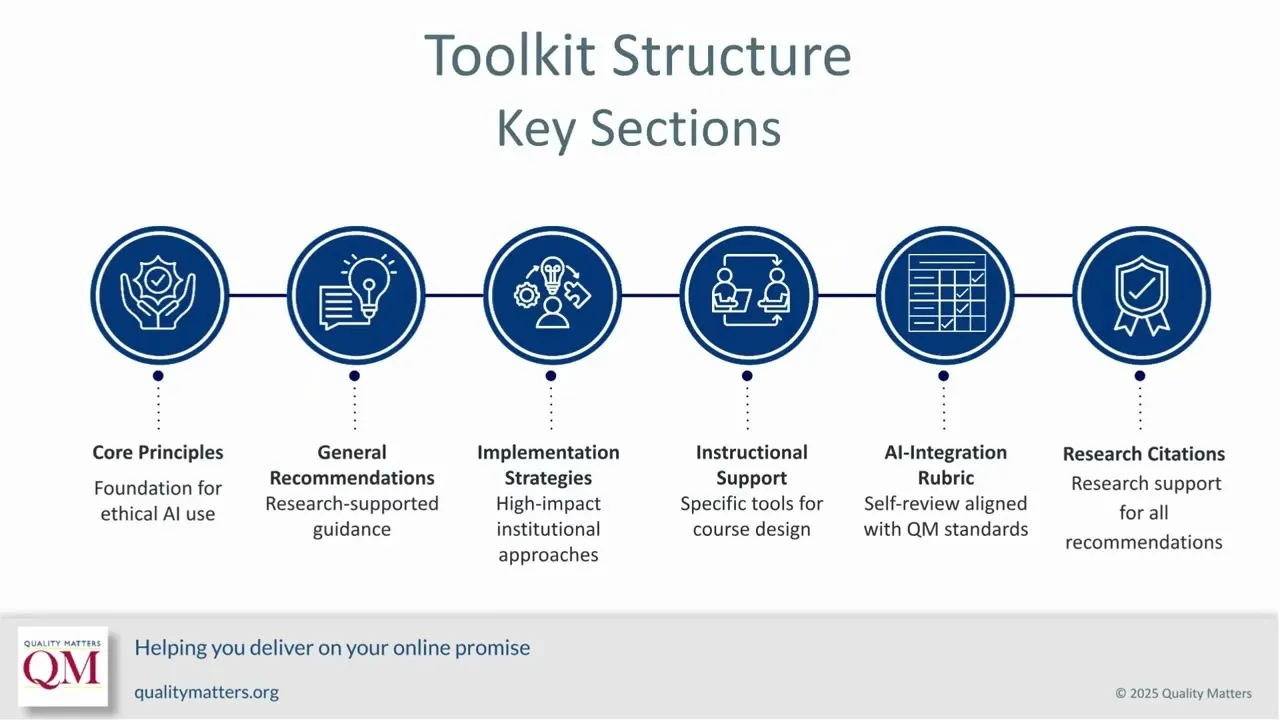
The AI principles shown below are designed to lay the foundation for strategic AI integration, ensuring the quality and ethical use of AI across the School of Professional Studies. These principles are intended to be used in compliance with the overarching AI policies established by Columbia University: CU Generative AI Policy
- Use AI to enhance, not replace, human connection and critical thinking
- Maintain instructor agency and meaningful student-instructor interaction
- Preserve opportunities for authentic collaboration and community building
- Let learning goals drive AI use to ensure technological affordances enhance pedagogy
- Communicate clearly with students about AI use across courses and programs
- Provide student agency and opt-out options where feasible
- Be transparent about data privacy and security practices
- Implement AI with respect for user autonomy and data integrity
- Choose AI tools that support diverse learning needs and backgrounds
- Conduct regular bias audits and inclusive design practices
- Pursue accessibility as a baseline requirement, not an afterthought
- Move from detection-based to design-based approaches
- Focus on authentic assessment that harnesses AI as a tool
- Provide clear guidelines that promote learning while maintaining standards
- Evaluate AI tool effectiveness, currency, and accessibility regularly
- Adapt tools based on emerging research and best practices
- Demonstrate flexibility to evolve with technological advancement
3. Instructor Access to AI Tools
CUIT maintains a webpage for all AI solutions that are currently available from the central University. Below is a table summarizing these tools and their current availability so that SPS instructors can make informed decisions around the use of these tools. It is important to note that more tools will become available as CUIT continues its vetting and procurement process. So be sure to check the website prior to each new semester to see if anything has changed.
Frequently Asked Questions
What is the key difference between CU CHAT and ChatGPT Education?
CU CHAT is the more affordable ‘pay-per-use’ option, and ChatGPT Education is a premium offering with advanced capabilities. Neither of these solutions is currently available for student use. CUIT has created this side-by-side comparison to help instructors and staff decide which solution makes the most sense for the intended purpose.
Why would an instructor use these AI tools instead of a consumer-facing “private” account?
These tools operate in a ‘walled garden’ environment approved for use at Columbia University. Your data will not be used to train these models or sold to third-party companies (unlike consumer accounts). These accounts also offer the benefit of enterprise-level data encryption and security, which is not typically found on consumer accounts.
Can my students use any of these tools?
Currently, the only tools available for student use are Gemini and NotebookLM, which are now free to all LionMail users as of 2025. However, additional AI tools will become available for student use in the near future.
CUIT’s Emerging Technology Consortium (ETC) organizes monthly webinars for the AI Community of Practice, which highlight trending topics in AI and feature industry experts (OpenAI, Google, Anthropic, etc.). This forum is also where CUIT commonly announces new AI services, training, and pilots. We highly recommend joining this community to participate in order to stay in the loop with new developments in AI and how the Columbia community as a whole is responding to these changes.
About the AI Community of Practice
Emerging Technologies' AI: Community of Practice (AICoP) is a multidisciplinary congregation of curious minds, eager to delve into the realms of artificial intelligence (AI) and machine learning (ML). The community is a platform for learning, discussion, and application of AI principles across various fields of study at Columbia University. We aim to demystify AI, spur innovation, and approach challenges with a fresh, AI-centric perspective through regular meetings, workshops, and collaborative projects. All while fostering a culture of inclusivity, respect, and collective growth.
We encourage Columbia Researchers, Faculty, and Administrators interested in joining to send in your interest intake form.
2025 AICoP Webinars
- AICoP: Practical AI - Clear Prompts, Useful Context 11/21/25
- AICoP: Introducing Gemini and NotebookLM 10/31/25
- AICoP: Introducing CHAT (CUIT Hosted AI Toolkit) 9/26/25
- AICoP: AI for Justice - Building Chatbots for Legal Aid 5/30/25
- AICoP: Understanding Agentic AI 4/25/25
- AICoP: Reasoning at Scale - From GPT to DeepSeek 3/28/25
- Columbia and OpenAI Forge a Groundbreaking Partnership with ChatGPT Enterprise 2/26/25
- Embracing AI: Insights from Columbia Technology Ventures 1/29/25
4. Additional AI Resources
AI Literacy Frameworks
- AI Literacy in Teaching and Learning: A Durable Framework for Higher Education (EDUCAUSE)
- AI Course Compass: A Seven-Phase Framework for Ethical, Equitable, and Adaptive Course Design (OLC)
- Our Approach to Generative AI - AI Literacy Pyramid Framework (Barnard College)
AI Foundations
- “Attention is All You Need” (Vaswani et al., 2017)
- What is generative AI and how does it work? – The Turing Lectures with Mirella Lapata
Accessibility
- AI, Accessibility, & Syllabus design (MIT Sloan blog post--helpful insofar as it puts the how AI can help with accessibility question in a concrete context)
Academic Integrity
- AI detectors don't work; here's what to do instead from MIT Sloan (Set clear policies and expectations; promote transparency and dialogue; Foster intrinsic motivation; Ensure inclusive teaching)
- AI Detection Tools Falsely Accuse International Students of Cheating
- CU Center for Student Success & Intervention - Documentation on policies & protocols regarding academic integrity - https://cssi.columbia.edu/content/academic-violations
- SPS Turnitin Fact Sheet and TII’s AI detection documentation
AI Ethics
- The AI Roadmap: How We Ensure AI Serves Humanity (Center for Humane Technology)
- Ethics of Artificial Intelligence (UNESCO)
- OECD AI Principles (OECD)
- The EU Artificial Intelligence Act (EUAIA)
- Ethics of Artificial Intelligence and Robotics (Stanford)
- AI Ethical Guidelines (EDUCAUSE)
Sustainability and AI
- Generative AI’s Environmental Impact (MIT News)
- Sustainability in the Age of AI (SPS)
- Artificial Intelligence for Climate Change Mitigation Roadmap (ICEF)
- From Chaos to Code: How AI Can Tame the Climate Crisis | Columbia AI Summit
- Can We Mitigate AI’s Environmental Impacts? (Yale School of Environment)
AI Resources at Columbia University
- Columbia Generative AI Policy
- Artificial Intelligence (AI) Policy For Faculty (SPS)
- Columbia AI Services | CUIT
- AI Literacy Training | CUIT
- Best Practices for Responsible AI Use at Columbia University
- Columbia AI Events
- Columbia AI Summit
- Columbia AI Community of Practice
- A Columbia Prompt Library for Effective Academic AI Use
- Teaching and Learning in the Age of AI | CTL
- AI in Education: Digital Futures Institute | Teachers College
- Machine Learning and AI Series | Data Science Institute
- AI Activation Network | Data Science Institute